Site Map  enter code:

Numbers — Charts:

History:

Analyses:


    Contact    

a usgovernmentspending.com briefing:

smaller text  bigger text    print view

US Pensions Spending History from 1900


In 1902 governments in the United States spent nothing on pensions programs. In 2000 governments spent about 5.5 percent of GDP on pensions programs, rising to 7.0 percent GDP in 2020.

A Century of Pensions Spending


Pensions spending by governments increased rapidly during the second half of the 20th century.

Pensions Spending in 20th Century

Chart 2.71: Pensions Spending in 20th Century

Government pensions spending, including both pensions for government employees and government pensions for workers, like Social Security, started out at the beginning of the 20th century at zero percent of Gross Domestic Product (GDP). Pensions increased very slowly during the first half of the century. It was only in 1931 that government pension expenditure reached 0.12 percent of GDP. By the beginning of World War II pension expenditure had doubled — all the way to 0.22 percent of GDP.

After World War II pension expenditures, now including Social Security payouts, began to accelerate, reaching 1 percent of GDP by 1953 and doubling to 2 percent of GDP by 1958. Pension expenditure reached 3 percent of GDP by 1971 and 4 percent by 1974. Pension expenditure breached 5 percent of GDP in 1980.

The ramp-up in pensions expenditure began to moderate after 1980, reaching 5.1 percent of GDP in 1990 and 5.3 percent in 2000. Pension spending breached 6 percent of GDP in the recession year of 2009, hitting 6.39 percent of GDP in that year. Pensions expenditure was 6.8 percent of GDP in 2015, 7.1 percent of GDP in 2020.

In 2025 pensions spending is estimated at 6.83 percent GDP.


Government Pensions Before Social Security

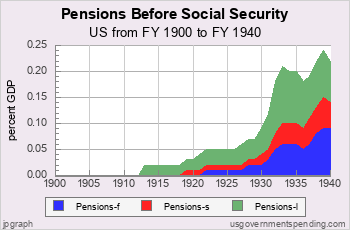
Government spent modest amounts on pensions in the first half of the 20th Century.

Pension Spend Before Social Security

Chart 2.72: Pension Spend Before Social Security

At the start of the 20th century governments spent nothing on civil pensions. This began to change right before World War I as local governments began to implement pensions programs for their employees.

Chart Key:
- Local pensions
- State pensions
- Federal pensions

After World War I the federal government and state governments started to show expenditures on pension programs for their employees. The total cost of these programs had reached 0.1 percent of GDP by 1930.

Pensions spending surged in the during the Great Depression with federal spending reaching 0.08 percent of GDP, state pension spending reaching 0.05 percent of GDP and local government pension spending reaching 0.08 percent of GDP by 1940.

Government Pensions in the Social Security Age

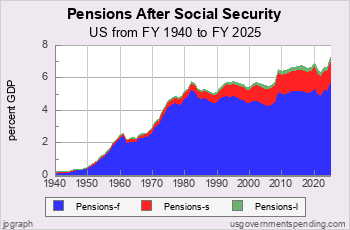
Social Security dominates pension spending in the United States.

Pensions in Social Security Age

Chart 2.73: Pensions in Social Security Age

Since the passage of Social Security Act in 1935 the program has come to dominate government pension spending. Starting at 0.08 percent of GDP in 1940 federal pension spending reached 1.15 percent of GDP in 1955 and 2.15 percent of GDP in 1960. In the early 1960s federal pension spending stabilized before resuming its growth in the late 1960s, breaching 3 percent of GDP in 1972.

Chart Key:
- Local spending
- State spending
- Federal spending

The main ramp-up in Social Security spending occurred between 1965 and 1982, when federal pension spending rose from 2 percent of GDP to 5 percent. In the years after 1980 Social Security spending went into a modest decline, bottoming out at 4.2 percent of GDP in 2006. But the Great Recession and the retirement of the post-World War II baby boom has reversed that, and federal pension spending reached 5.23 percent of GDP in 2015. in 2020 federal pension spending was 5.5 percent of GDP.

In the post-World World War II era, as Social Security spending was ramping up, the pace of state and local pension spending remained fairly modest. But by 1991 state pension spending reached 0.5 percent of GDP and local pension spending hovered at 0.16 percent of GDP.

By 2010 state pension spending had more than doubled to 1.15 percent of GDP and local pension spending has nearly doubled to 0.25 percent of GDP. In 2015 state pension spending was 1.29 percent GDP and local pension spending was 0.27 percent GDP. In 2020 state pension spending was 1.34 percent GDP and local pension spending was 0.27 percent GDP.


Government Employee Pensions Since World War II

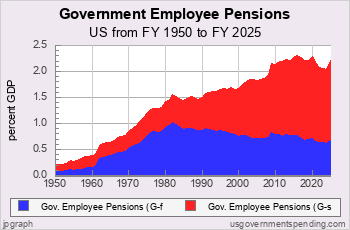
Government employee pension payouts amount to 2.3 percent of GDP

Government Employee Pensions

Chart 2.74: Government Employee Pensions

In 1950 the total payout on government employee pensions was 0.21 percent of GDP: federal at 0.09 percent, state at 0.05 percent, and local 0.09 percent of GDP. Then they started to grow.

For three decades federal employee pension payouts dominated. Federal pensions reached 0.5 percent GDP in 1970 and peaked at 1.03 percent of GDP in 1982, declining thereafter to 0.71 percent of GDP in 2005. Since the mid 2000s federal pensions have increased, hitting 0.8 percent GDP in 2009, before declining to an estimated 0.77 percent GDP in 2015. in 2020 federal employee pensions were 0.73 percent of GDP.

Chart Key:
- State and Local employees
- Federal employees

In recent years, state and local government pensions have dominated. (Most states run pension plans for both their state government and local government employees.) State and local pension payouts reached 0.2 percent of GDP in 1957, 0.3 percent GDP in 1964, and 0.5 percent GDP in 1982. Then state and local pensions started to accelerate, hitting 0.8 percent GDP in 1995 and 1.05 percent GDP in 2002. State and local pension payouts hit 1.5 percent GDP in 2015. In 2020 state and local employee pension payouts were 1.55 percent of GDP.

Spending 101 Courses

Spending | Federal Debt | Revenue | Defense | Welfare | Healthcare | Education
Debt History | Entitlements | Deficits | State Spending | State Taxes | State Debt


There’s More...

usgovernmentspending.com.

Where you go to get facts about government.

Prepared by Christopher Chantrill.
email: chrischantrill@gmail.com

Click the image on the right to buy usgovernmentspending.com’s ebook.
It costs only $1.99 and it contains all the analyses of spending history
on the website and more.

Suggested Video: All About Debt

Top Spending Requests:

Find DEFICIT stats and history.

Get WELFARE stats and history.

US BUDGET overview and pie chart.

Find NATIONAL DEBT today.

DOWNLOAD spending data or debt data.

See FEDERAL BUDGET breakdown and estimated vs. actual.

MILITARY SPENDING details, budget and history.

ENTITLEMENT SPENDING history.

See BAR CHARTS of spending, debt.

Check STATE spending: CA NY TX FL and compare.

See SPENDING ANALYSIS briefing.

See SPENDING HISTORY briefing.

Take a COURSE at Spending 101.

Make your own CUSTOM CHART.

Spending Data Sources

Spending data is from official government sources.

Gross Domestic Product data comes from US Bureau of Economic Analysis and measuringworth.com.

Detailed table of spending data sources here.
Medicare breakdown here; Medicaid breakdown here.

Federal spending data begins in 1792.

State and local spending data begins in 1820.

State and local spending data for individual states begins in 1957.

More Topics

Federal Yield Curve
Click to view

Gross Federal Debt

Debt Now:  $39,209,984,063,577.76
Debt 2/2020:$23,409,959,150,243.63

Site Search

Win Cash for Bugs

File a valid bug report and get a $5 Amazon Gift Certificate.

Get the Books


Price: $0.99
Or download
for free.

From
usgovernment
spending.com
Price: $1.99

Life after liberalism Price: $0.99
Or download
for free.

US Government Spending 2020: only 99¢.

US Government Spending 2012: free.

Blog

Medicare/Social Security 2026 Trustees Report Released

On June 16, 2026, the Center for Medicare Services released its annual Medicare Trustees Report, which projects Medicare spending out to 2095.  As in the past, the report shows that federal health-care programs will eat the budget.

In this report the Trustees forecast that Medicare will top out at a little above 6 percent of GDP in the 2080s.

On June 15, 2026, usgovernmentspending.com updated its chart of the Medicare Outlook here based on data in the 2026 Medicare Trustees Report.  You can download the data and also view selected Medicare Trustee forecasts going back to 2005.


In June 2026, the Social Security Administration released its annual OASDI Trustees Report, which projects Social Security spending out to 2095.  As in the past, the report shows that Social Security spending will max out at about 6 percent of GDP. UsGovernmentspending.com uses the Supplemental Single Year Tables.

On June 15, 2026, usgovernmentspending.com updated its chart of the Social Security Outlook here based on data in the 2026 OASDI Trustees Report.  You can download the data and also view selected OASDI Trustee forecasts going back to 1997.

CBO Long Term Budget Outlook for 2026
On February 25, 2026 the Congressional Budget Office released its annual Long Term Budget Outlook for 2026, which projects ...

Gross State Product for 2025
The US Bureau of Economic Analysis (BEA) released its Gross State Product (GSP) data for 2025 on April 9, 2026.Usgovernment ...

> blog

Budget News

> archive

Spend Links

us numbersus budgetcustom chartdeficit/gdpspend/gdpdebt/gdpus gdpus real gdpstate gdpbreakdownfederalstatelocal202420252026californiatexas

Masthead

usgovernmentspending.com was designed and executed by:

Christopher Chantrill.

Email here.


presented by Christopher Chantrill

Data Sources  •   •  Contact

closed